|
|
|
Subtotal: |
0 |
|
 |
|
|
|
|
ARobotThis project was submitted to Parallax by Roger Arrick of Arrick Robotics
The ARobot (pronounced "A robot") is a computer controlled mobile robot designed for Experimenters and Educators. Ages 14 and up (younger with help) can enjoy unlimited experimentation by programming the on-board BASIC Stamp 2 control computer. Learn about computer programming, motion control, sensors, path planning, object avoidance, and more. Easily assembled in a few hours using common hand tools (no soldering required). The ARobot is connected to a personal computer for programming.
Features:
- Rugged aluminum frame (no plastic or wood)
- Dual front whisker sensors
- Rear wheel steering servo motor
- Front wheel DC gear drive motor
- Optical wheel encoder for distance measurement
- On-board coprocessor handles all motor control
- Controllable Red and Green LED's
- Sound output transducer
- Two user defined push button switches
- 3 User-defined RC servo control ports
- Serial communications port
- Expansion connector
- Socket to accept a BASIC Stamp 2 microcontroller
- Dimensions: 10" x 10", 5" tall, 2-1/4 lbs
- Runs on 8 AA-cell batteries for 5 hours or more
BASIC Stamp 2 is the ARobot's programmable brain
The BASIC Stamp 2 is a small, self-contained computer controller manufactured by Parallax Inc. This easy-to-use system is programmed using a Basic-like language called PBASIC. Programs are written on an IBM-style PC then downloaded to the BASIC Stamp 2 for execution. Large libraries of programs can be created and saved.
ARobot's controller board accepts the BASIC Stamp 2 (not included) which controls motors, LED's, buzzer, and other devices. The Parallax Web site provides complete information about the BASIC Stamp microcontroller line as well as a free download of the programming manual.
Uses of ARobot
Robotics education Artificial life experiments Science projects Navigation research Maze solving Security Robot contests
What you get
Quality aluminum robot body and frame components Controller circuit board - completely assembled Diskette containing programming tools and example programs Wheels, drive motors, steering motors, encoder, cables Construction and user guide Technical support via web site and email Add your own BASIC Stamp module
What you need ARobot can be built and programmed by almost anyone!
Common handtools - screwdriver and pliers Your choice of spray paint (if desired) Personal computer running Windows and a serial port Common understanding of computer usage Moderate understanding of Basic programming or a willingness to learn 8 AA batteries. (over 5 hours of continuous run time) BASIC Stamp 2 programming information -available free on the net, or purchase the book Internet connection for getting the latest information A never-ending desire to experiment and play with robots! Construction normally takes about 3 hours. - or more for exotic paint jobs!
Expandability
ARobot's controller board has the ability to control 3 additional RC (Remote Control) servo motors which are commonly available at hobby stores for less than $20 each. These motors can be used to create a small robot arm or a moving head. The body contains openings to mount 2 of these RC servo motors.
The controller board also provides a connector to power a small DC motor like the one used as the drive motor. This connector can also be used to control other high-power devices such as a light or horn.
An expansion connector is provided to allow the user to add many special devices. Access to all of the BASIC Stamp module's I/O signals is provided and unused pins can be wired as needed.
Additional circuit boards can be stacked on top of ARobot's main controller board. Mounting holes and dimensions are the same as the prototype boards (RS Catalog #276-170) and breadboards (RS Catalog #276-174) found at RadioShack. This makes expansion easier and at a low cost.
Visit the Arrick Robotics project page for ideas such as using a sonar range finder and interfacing to a smoke alarm.
The expansion port offers:
- All BASIC Stamp I/O signals
- Coprocessor network signal
- 3 standard RC servo motor signals
- Access to coprocessor network bus
- User defined signals
- Standard 40 pin flat ribbon cable
- Other signals can be wired by user
Possible devices include:
- Additional whiskers
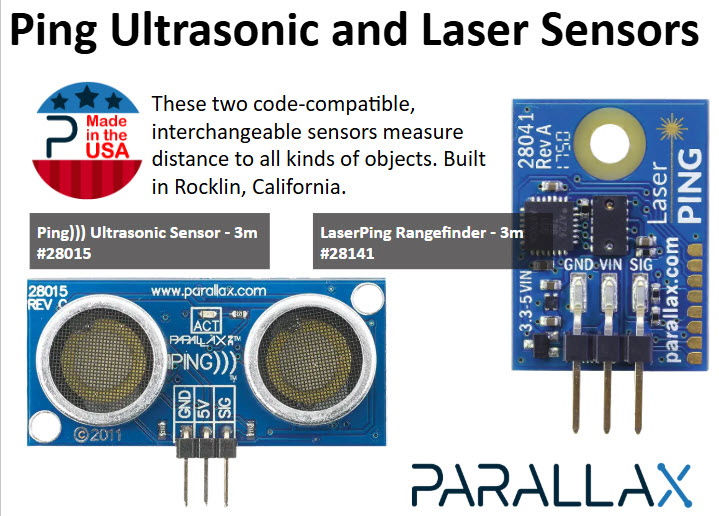
- Sonar range finder
- Smoke detector
- Light sensors
- Digital compass
- Tilt sensors
- IR communications
Technical Specifications
Frame: .062 aluminum - cut, punched, and formed Configuration: 3-wheel, front wheel drive, rear wheel steer Dimensions: 10" x 10", 5" tall, 2-1/4 lbs Payload capacity: 3 lbs Wheel size: 3.25" diameter Drive Motor: 12 volt DC gear motor, 1.6 amp max Quality machined wheel coupling and bearings Optical wheel encoder for distance measurement Encoder (shown below): 20 counts per revolution - 2 per inch of travel Motor driver: H bridge - 1 amp max Speed control: Pulse Width Modulation Controller PCB size: 2.1" x 6" Steering Motor: Standard size RC servo motor Power source: 8-AA cells in removable pack Runs on 8 AA-cell batteries for 5 hours or more Current draw: 50ma at standstill, 200ma with motor running Coprocessor: PIC16F84 for motor control Expansion connector - 40 pin (2x20) IDC .1 centers
Visit the Arrick Robotics web site for more information. |
|